AI that reads a venture’s evidence, not its pitch.
JIT-PATHS confirms where a venture really stands, warns of the risks ahead before they bite, and brings the right document and learning material at the moment they are needed: from a working idea to a delivered, industrialised result.
Ventures rarely stall on the technology
They stall on what was not visible in time: a customer or off-taker not yet committed, an approval route underestimated, a funding gap at the wrong moment, a missing person in the team. Teams cannot plan all of this up front, and they rarely know which question to ask next.
General-purpose AI answers well, but only what it is asked, and it takes a team’s account of its position at face value. JIT-PATHS closes that gap.
Three things, in the flow of real work
Where the venture really stands
The team’s account is the starting point. JIT-PATHS checks it against documents and targeted questions, and never crosses a valley of death on the team’s word alone.
The risk ahead, before it bites
It raises what the team has not yet asked about: the commitment not signed, the approval route, the funding gap. Early, while a correction is still cheap.
The right knowledge, at the right moment
For each risk, the document line that answers it and the teaching that bears on it arrive with the work, not in a course weeks earlier.
See it in a two-minute illustration with a fictional energy venture →
Compared with what teams use today
Position validated, not taken on trust
Every reading of a venture’s position rests on what it can show.
A general AI takes the team’s account at face value.
Warns before it is asked
It surfaces the questions the team did not know to ask.
A general AI answers only the question in front of it.
Learning when it counts
Teaching arrives linked to the risk and the decision at hand.
Front-loaded training is forgotten by the time it is needed.
Anchored on the documents that matter
Every risk points to the venture document and requirement line that answers it.
Traceable
Each recommendation traces back to its evidence and the rule behind it.
Remembers the journey
What was done and what is still open, from concept to market.
Sector-specific on one platform
Fourteen sector profiles, each with its approvals, gates and failure modes.
Your content stays yours
Partners connect their own material; it stays their property.
The team decides
It builds the competence and confidence to make the call; it does not make it for them.
Context from data, not from prompts
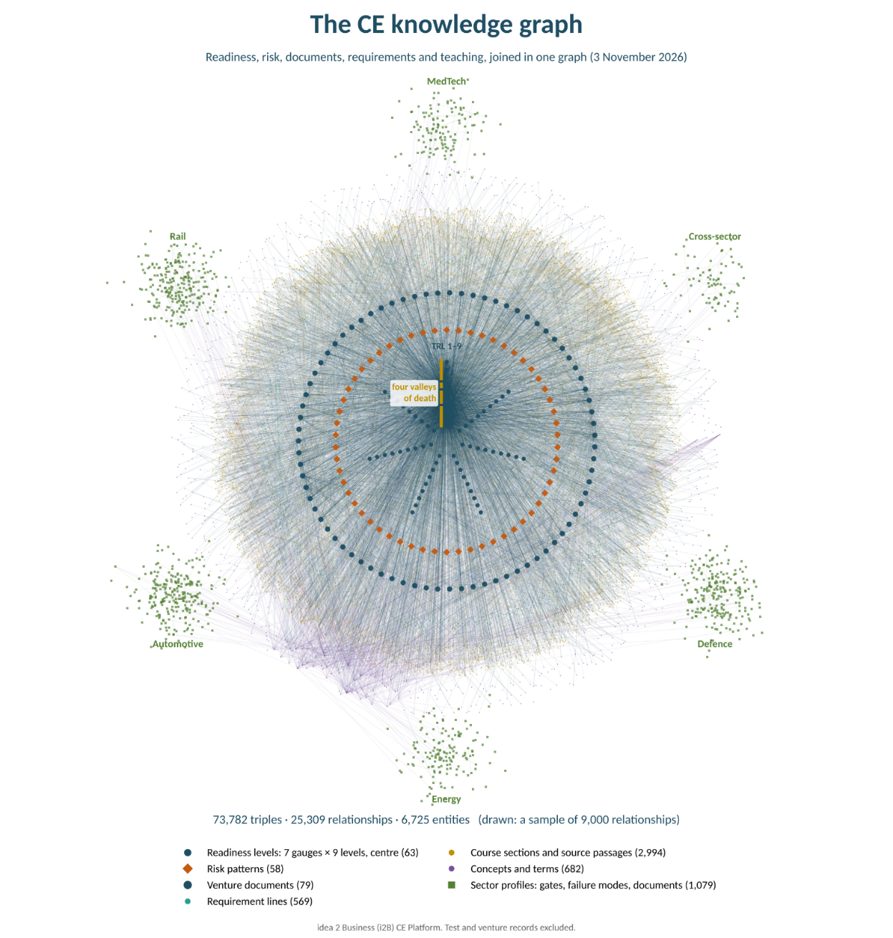
JIT-PATHS joins two kinds of context. System context: a structured model of how industrialisation unfolds, covering readiness levels and the valleys of death between them, the risks typical at each stage, the documents a venture must produce, and the rules of its sector. User context: what this venture has done and can show.
An ontology links the two in a knowledge graph, and the AI works from that graph rather than from a prompt. Readiness is treated as a profile anchored on the nine technology readiness levels, and the weakest point governs.
The platform is separate from the content. The method, model and engine are i2B’s. A partner’s courses, guides and case material can be connected as its own corpus, attributed to it and served only in its deployment.
Counts as of 3 November 2026.
One platform, fourteen sector profiles
The energy transition is already provided for: generation, storage, networks, end use and hydrogen, with the South African grid codes, REIPPPP and the EU Battery Regulation built in, alongside a battery value chain from ore to containerised storage and a beneficiation profile for local processing of critical minerals.
Local value creation. The question is rarely only whether a technology works; it is how much of the value is created locally. JIT-PATHS opens a product into its subsystems and parts and asks, for each, whether to make it locally, buy it locally or import it, and what is missing to move up a level.
i2B’s Local Value Creation Pyramid
- Owning the product system and its IP
- Emerging capability, needs investment or a partner
- Proven but latent capability
- Established capability, ready now
For those who build ventures, and those who back them
Innovation agencies and funders
A portfolio view on evidence: where each venture stands and what it needs next, on the same basis for all, including at application.
SETAs and skills bodies
Learning in the flow of work, configured by role, with a record of skills applied rather than courses completed.
Development finance
The risks that usually surface after the money is committed, raised while they are still cheap to fix.
Research and technology organisations
TRL as the shared language, with support through the scale-up gap from pilot to first plant.
Foundations and prize programmes
From award to lasting enterprise: support for the journey that decides a prize’s impact.
Founders and project teams
A clear position, the next step, and the knowledge to take it well.
Built, tested internally, and ready for its first real users
The platform is built and has been tested internally with AI test panels on synthetic and historical ventures. Its first use with real innovators is the next step. We publish what our tests show, including where an idea did not hold.
- In our internal tests, every source JIT-PATHS cited (160 of 160) could be traced to a real record.
- Two independent raters agreed closely on its readiness readings (kappa 0.92 across 72 grades).
- In an internal test of six cases, a general AI model without the venture’s context steered 4 of 6 self-funded founders towards selling equity; JIT-PATHS steered none.
These are internal measurements on test cases, not results with live users. Personal data is handled under POPIA and kept apart from the platform’s knowledge.
Talk to us
Whether you want to connect your own content, explore a pilot with a cohort, or simply see it working, we would be glad to hear from you.
Email: harry.teifel@idea-2-business.com
idea 2 Business (Pty) Ltd · Prof. Harry Teifel